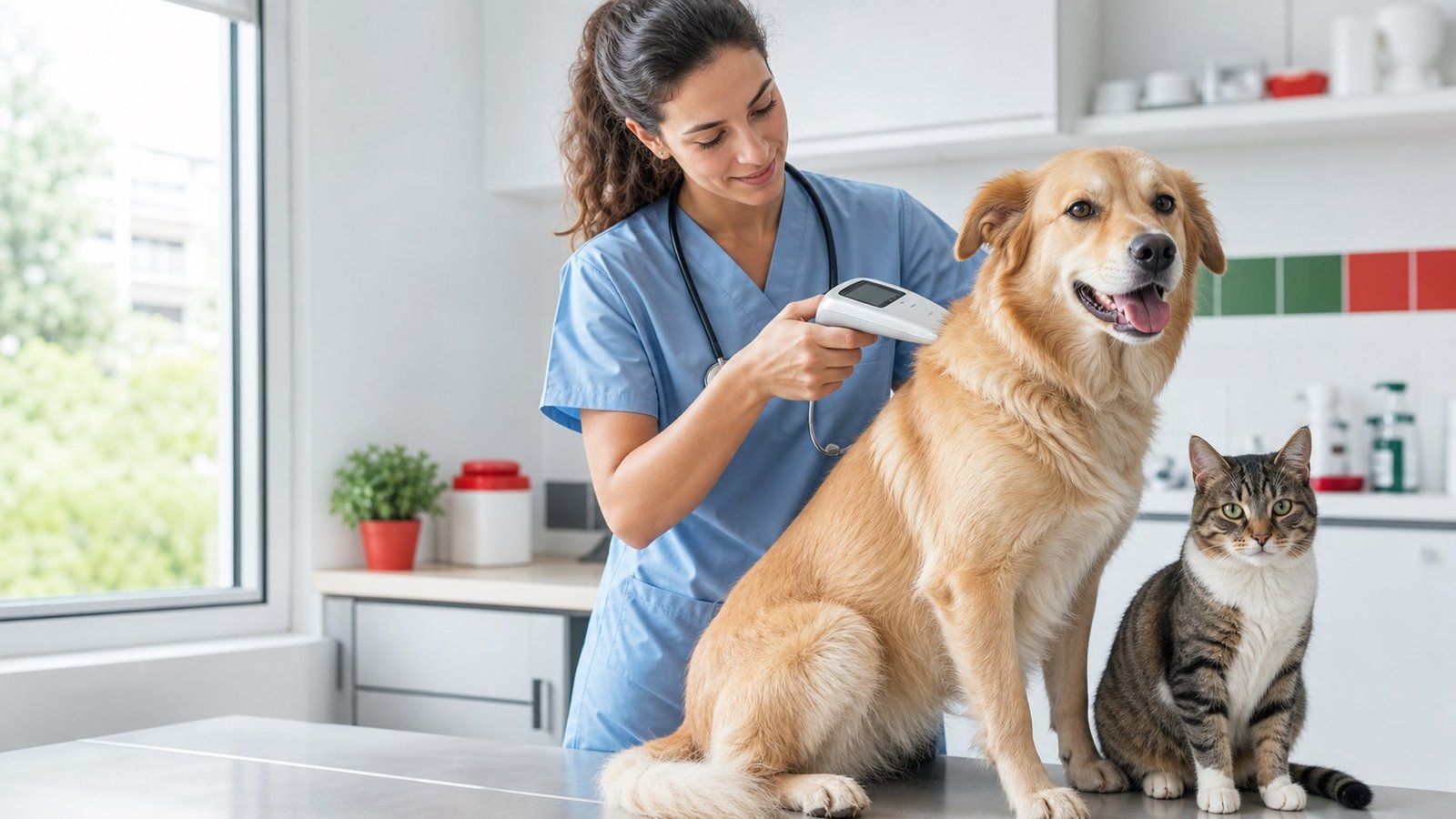
Moving house? Check your pet’s record too
- Keep the microchip number and current DIAC together. A microchip is an identification link, not a location tracker.
- SIAC says a change of your residence or the animal’s accommodation must be notified within 15 days; keep telephone details current.
- Use SIAC TITULARES or the official update form. Check the resulting DIAC before filing it with the animal’s documents.
Bringing pets to Portugal · Dog-friendly places and beach checks
Action checklist added: 6 October 20261. Practical road map
2. Veterinary care in Portugal
Most routine and emergency care is provided by private practices, clinics and hospitals, collectively referred to in law as CAMV facilities. Municipal veterinarians work in rabies campaigns, official collection centres, public-health duties and certain licensing cases. University hospitals may provide referral and specialist services.
When choosing a clinic, ask whether “24 hours” means an on-site clinical team or an on-call service. Check intensive care, imaging, surgery, laboratory and exotic-pet capability. Keep a concise medical summary, medication list and microchip number ready.
3. Emergencies and poisoning
Breathing difficulty, collapse, uncontrolled bleeding, road trauma, a swollen abdomen, seizures, heat stroke, suspected poisoning or inability to urinate require urgent veterinary assessment. Do not induce vomiting or give milk or human medicines unless a veterinarian specifically instructs you.
Bring the package or a photograph of the suspected substance. Heat, processionary caterpillars, rodenticides, xylitol, chocolate and human medication are important risks in Portugal.
4. Compulsory microchipping
Dogs, cats and ferrets must be marked with a transponder and registered in SIAC. Animals born after 25 October 2019 must generally be marked and registered by 120 days of age. The transition period for older cats and ferrets ended on 25 October 2022.
Only a veterinarian may implant the chip. It is not GPS; it links a scanned identification number to the keeper record. For travel, rabies vaccination must follow identification, not precede it.
5. SIAC registration and DIAC
SIAC links the chip, animal and responsible keeper. An accredited veterinarian normally completes the initial record. A compliant animal coming from abroad must be entered in SIAC if it remains in Portugal for 120 days or longer.
Check the chip number, keeper name, address, email and telephone. Depending on access, changes may be made through SIAC or via a vet, municipality or parish council.
6. Bringing a pet from Turkey
This section concerns non-commercial movement of up to five dogs, cats or ferrets accompanying their owner, or an authorised person travelling within five days of the owner, with no sale or transfer of ownership. Other situations may fall under commercial import rules.
- Microchip: use a compliant transponder and ensure the same number appears on every document.
- Rabies vaccination: the animal must be at least 12 weeks old; a primary vaccine cannot predate identification and generally becomes valid after 21 days.
- Rabies titration: recheck the EU country list for the travel date. Where required, sample at least 30 days after vaccination, use a designated laboratory, obtain at least 0.5 IU/ml and allow at least three months from blood sampling to entry.
- Official animal health certificate: have it completed/endorsed by the competent official service. It is generally valid for ten days up to the EU entry check.
- Non-commercial declaration: include the owner’s declaration.
- Aviso de Chegada: notify the Portuguese point of entry using DGAV’s current form and deadline.
- PEV check: enter through a designated Travellers’ Point of Entry for documentary and identity checks.
DGAV states that Lisbon Airport’s PEV is closed from midnight to 06:00. Verify operating hours, email, notice period and fees for the actual airport before buying a flight.
7. After arrival in Portugal
Retain the endorsed entry documents. Arrange a local health check, scan the chip and review vaccinations and parasite protection. If the pet will stay for at least 120 days, complete SIAC registration with an accredited vet.
- Save the nearest emergency hospital.
- Match the chip number to the certificate or passport.
- Complete SIAC and obtain DIAC for a 120+ day stay.
- Discuss an EU Pet Passport if future EU travel is planned.
- Check rabies and licensing duties for a dog.
8. Vaccination and preventive health
Portugal requires a valid rabies vaccination for dogs aged three months or more. Domestic rabies vaccination is not generally compulsory for cats, but valid vaccination is required for international travel by dogs, cats and ferrets.
Core vaccines and leptospirosis should be risk-based. Leishmaniasis, heartworm, ticks and fleas vary by region. Never use a dog-only antiparasitic product on a cat without veterinary confirmation.
9. EU Pet Passport and onward travel
An EU Pet Passport is an official travel document issued by an authorised EU veterinarian; it is not simply a vaccination booklet. EU movement normally requires compliant identification, a valid rabies vaccine and the passport. Dogs travelling to Finland, Ireland, Malta, Norway or Northern Ireland may require Echinococcus treatment 24–120 hours before arrival.
10. Parish council dog licensing
The initial SIAC record generally acts as a licence for the first year. Confirm subsequent annual procedures and local fees with the Junta de Freguesia. Dangerous and potentially dangerous dogs require a special licence, normally within 30 days of SIAC registration.
11. Dangerous and potentially dangerous dogs
A dog may be legally dangerous because of an incident history; “potentially dangerous” may follow listed breed/type criteria. The special regime names pit bull terrier, Rottweiler, American Staffordshire terrier, Staffordshire bull terrier, Dogo Argentino, Fila Brasileiro and Tosa Inu, including relevant crosses.
Licensing, fitness/criminal-record evidence, liability insurance, training, neutering, short lead and functional muzzle rules may apply. Do not rely on an old fixed insurance amount; verify the current legal and policy requirements.
12. Address, ownership, loss and death
Changes such as keeper contact details, ownership transfer, loss, recovery or death must generally be reported to SIAC within 15 days.
| Event | Action |
|---|---|
| Address or phone change | Update via SIAC access, vet, parish council or municipality. |
| Lost pet | Report promptly to SIAC and contact police, the municipal collection centre and local clinics. |
| Transfer | Complete the formal transfer of ownership. |
| Death | Notify SIAC within 15 days and ask about lawful handling options. |
13. Housing and public places
Condominium decisions, lease clauses, noise, hygiene and common-area rules must be considered separately. The validity of a lease restriction can depend on the contract and current case law. Commonly cited housing limits are three adult dogs or four adult cats, with four animals in total; municipal-veterinary exceptions may be possible. Verify local rules.
Restaurants and shops may admit or restrict pets through visible notices; assistance-dog access has separate protection. Beach and park rules vary by municipality and season.
14. Costs, assistance and insurance
Private veterinary fees are not set by a single national tariff. Consultation, emergency surcharge, imaging, laboratory work, hospitalisation and surgery may be separate. Ask for a written estimate where practical.
Compare annual caps, deductibles, reimbursement, waiting periods, age limits, hereditary conditions, dentistry, third-party liability and overseas cover. Municipal sterilisation and microchip assistance is local and periodic.
15. Checklists
Before leaving Turkey
- Scan the chip and match every document.
- Confirm rabies vaccination follows the chip and remains valid.
- Complete titration on the correct dates where required.
- Count the waiting period from blood sampling.
- Obtain the current official health certificate.
- Confirm DGAV arrival notice and PEV hours.
- Obtain the carrier’s conditions in writing.
In Portugal
- Choose a local vet and emergency hospital.
- Complete SIAC and DIAC for a 120+ day stay.
- Review dog vaccination and licensing.
- Report record changes within 15 days.
- Check passport and destination rules before travel.
16. Frequently asked questions
Must every foreign pet enter SIAC within 30 days?
No. The general rule concerns a stay of at least 120 days; special dog regimes differ.
Are cats required to have a microchip?
Yes. Dogs, cats and ferrets are included in the SIAC system.
Is rabies vaccination compulsory for cats inside Portugal?
The domestic general mandate applies to dogs, but cats need valid rabies vaccination for international travel.
Is a Turkish vaccination booklet an EU Pet Passport?
No. The entry certificate and EU Pet Passport are different documents.
Does the microchip track location?
No. It links a scanned number to an up-to-date keeper record.