The amount of garbage in Portugal increased to 5.67 million tons: 16 points behind the recycling target
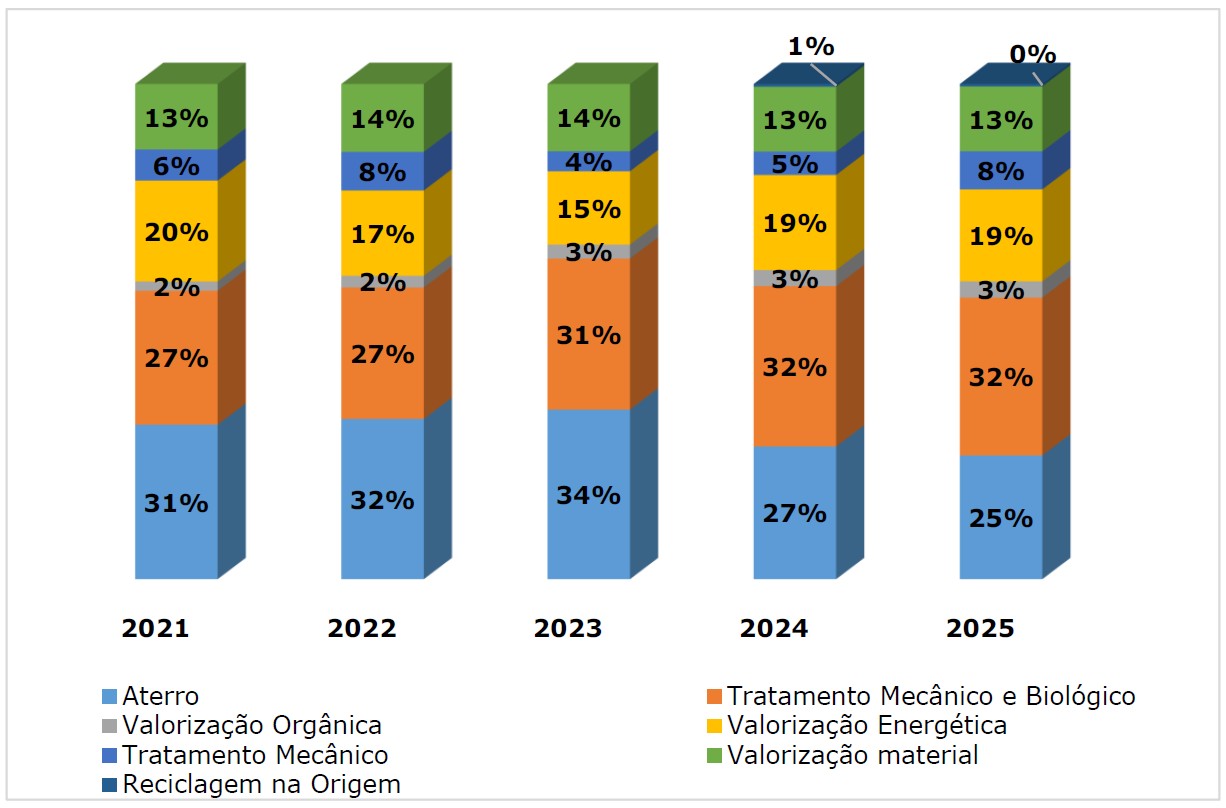
The amount of urban waste produced in Portugal in 2025 reached 5 million 667 thousand tons. According to data from the Portuguese Environment Agency (APA), waste production increased by 2.11% compared to the previous year. While the reuse and recycling rate in the country remained at 39%, the target set for 2025 was 55%. The disclosed data show that Portugal is having difficulty reaching the European Union targets in waste management.
How much garbage is produced per person in Portugal?
According to APA's 2025 data, a total of 5 million 667 thousand tons of urban waste was produced in Portugal.
This amount means a 2.11% increase compared to 2024.
Annual waste generation per capita in mainland Portugal was calculated to be approximately 494 kilograms.
The daily average is 1.35 kilograms.
However, urban waste statistics are not just about garbage generated at homes. It may also include some commercial and institutional wastes similar to household waste.
Therefore, the amount per capita should not be interpreted as an exact measurement of the waste a person produces directly at home.
Why was the recycling rate below the target?
Portugal's reuse and recycling target for 2025 was set at 55%.
The actual rate was 39%.
Thus, there was a difference of 16 percentage points between the target and the realization.
Although separate collection of waste is an important stage of the recycling process, it is not sufficient on its own.
materials collected separately It needs to be sorted, processed and turned into reusable raw material.
The losses incurred in these processes affect the final recycling rate.
Most of the garbage is collected mixed
APA data shows that in Portugal, approximately three-quarters of municipal waste is collected through a mixed collection system.
The share of separately collected waste is approximately one quarter.
This situation poses a significant problem in terms of separating recyclable materials at source.
In particular, the mixing of organic waste with plastic, paper and other waste can make recycling processes difficult.
According to APA's assessment, a system for separate collection or processing of biological waste is not yet implemented in 34 municipalities.
The largest waste group is organic materials
When the composition of urban waste in Portugal is examined, biological waste ranks first with approximately 37.42%.
Plastics account for approximately 10%.
Paper-cardboard and textile wastes are approximately 9% separately.
This distribution shows why separate collection of food waste and other biological materials is important for recycling goals.
However, municipalities' organic waste collection methods and the types of materials they accept may vary.
The goal of regular storage has also been moved away
In line with the European Union targets, landfills will be allocated to landfills by 2035. It is aimed to reduce the rate of urban waste sent to below 10%.
Portugal's current rate in the relevant indicator of the APA is approximately 52%.
On the other hand, the direct landfill rate is stated to be 25%, depending on the types of processes to which waste is first directed.
These two figures are based on different calculation methods.
Direct storage refers to sending the waste to the landfill in the first stage.
The final storage indicator can also take into account waste that is sent to storage after going through other processes.
Therefore, it is not correct to compare the two figures as if they were the same criterion.
What is changing for citizens?
The data announced on October 13 does not introduce a new garbage tax or mandatory payment for citizens.
However, it has important consequences in terms of improving the waste collection infrastructure of municipalities and expanding recycling services.
Residents of Portugal can check their municipality's separate collection services and organic waste systems.
The data reveal that further progress is needed in separating waste at source and increasing recovery capacity.
Resources
- Renascença / Lusa, “Produção de resíduos urbanos volta aumentar em Portugal, diz relatório”, 13 October 2026.
https://rr.pt/noticia/pais/2026/10/13/producao-de-residuos-urbanos-volta-a-aumentar-em-portugal-diz-relatorio/489060/
- Agência Portuguesa do Ambiente, Urban waste data.
https://apambiente.pt/residuos/dados-sobre-residuos-urbanos
Visit the original source to read full details.
Go to Source ↗