Mild outside, cold inside?
A sunny afternoon in Portugal does not guarantee a comfortable room that evening. Insulation, glazing, orientation, floor level and heating matter. Not every Portuguese home is cold, and outdoor temperature alone does not describe yours.
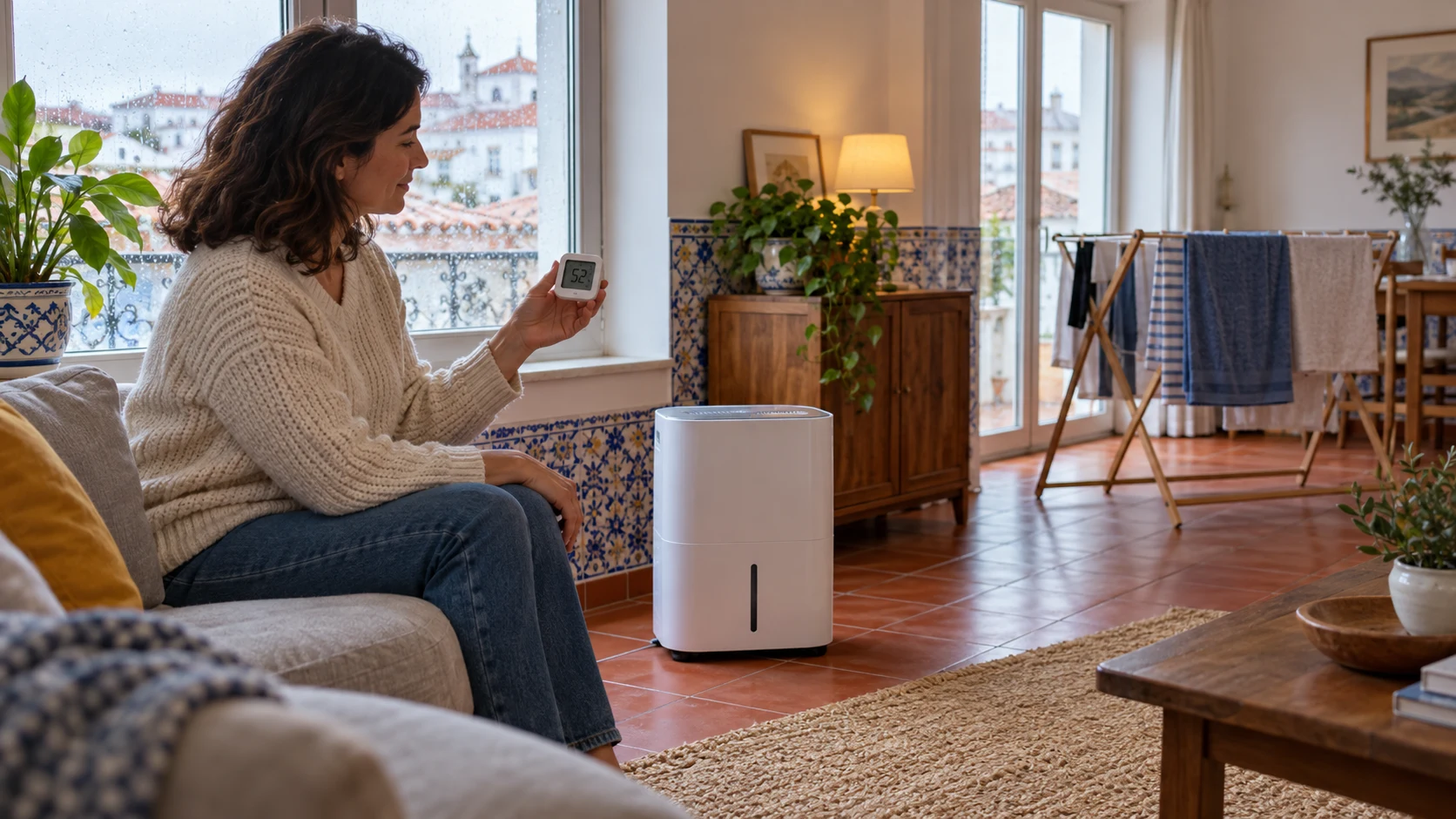
Before buying a large appliance, observe your home. Record morning/evening temperature and humidity in the same place for a week. Note wet windows, stains and differences between rooms. This helps both purchasing decisions and conversations with your landlord.
Prepare for your location
Prepare for rain on the northern coast, colder nights inland and at altitude, and rain/wind in Lisbon. Algarve sunshine can still be followed by cool evenings. On Madeira and the Azores, distinguish a coastal settlement from higher ground.
These are general planning differences, not a forecast for winter 2026–27. Consult the local station in IPMA’s 1991–2020 normals and check current weather warnings before travelling.
Measure temperature and humidity
Keep your thermometer/hygrometer away from direct sun, heaters and shower steam. Compare readings taken in the same location; one number cannot diagnose a building.
WHO considers 18°C a cold-season reference for protecting the general population; vulnerable residents may need warmer conditions. It is not a Portuguese tenancy temperature guarantee.
EPA recommends keeping relative humidity below 60% where possible, ideally 30–50%. This technical target is neither a legal limit nor a guarantee against mould. Condensation can still form on a very cold surface.
Condensation or a leak?
Condensation: moist air can form water on cold glass, corners and surfaces behind furniture. Leaks: stains growing after rain, persistent wet patches or water near plumbing need building/plumbing assessment. Appearance alone cannot establish the cause.
Remove shower/cooking moisture with appropriate ventilation; do not block vents. The drying effect of outdoor air depends on conditions—assess short, effective airing alongside measurements. Never dry laundry on a heater. Painting over mould does not remove its moisture source.
Seek professional assessment for extensive, recurring or hidden mould, water damage, or a household with vulnerable residents. Do not mix cleaning chemicals; follow labels. Seek medical advice for respiratory symptoms. This guide does not prescribe chemical mould treatments.
Choose heating for the way you use it
Resistance heaters using the same power for the same actual running time consume similar energy. Oil-filled radiators release heat gradually; fan heaters move warm air quickly. Oil-filled does not mean electricity-free. Thermostat operation and room heat loss change the bill.
A properly installed heat pump/air conditioner can transfer more heat into the room than its electrical input, depending on conditions. Efficiency varies with temperature, equipment and installation. Check labels, room suitability, noise and maintenance rather than treating one catalogue value as a promise.
For portable equipment, examine tip-over/overheating protection, thermostat, location restrictions and manufacturer clearance distances. Wet-room use requires suitable equipment. Fixed installation changes need an appropriate professional and attention to landlord permission.
Estimate heating with your own tariff
Formula: kW × actual operating hours × €/kWh. A 2,000 W heater at full power for 4 hours/day over 30 days uses 240 kWh. At an illustrative €0.25/kWh, the energy component is €60. This is not a market tariff or a complete bill estimate; taxes, standing charges and other items may apply.
A thermostat switching off reduces running time; the calculator assumes continuous full power. Suitable safe metering and actual bills are more informative. Compare fixed charges and contract terms as well as unit prices.
When protection trips
A heater, oven and kettle together may exceed contracted power. ERSE’s potência contratada simulator helps assess simultaneous appliances. Increasing the power tier can also affect fixed costs.
Tripping can instead indicate a fault or leakage. Stop using hot sockets, damaged cords or equipment with a burning smell and contact an electrician. Never bypass protective devices.
Do not trade ventilation for warmth
DGS stresses maintenance and proper ventilation for fuel-burning equipment. Keep flues and air paths clear. Do not heat a home with a gas cooker, oven, barbecue or outdoor heater.
Keep electric heaters clear of curtains, bedding and laundry by the manufacturer’s specified distances. Never cover them. Do not use extensions or multi-sockets contrary to instructions, and do not leave portable heaters running when away.
Headache, dizziness, nausea or several people becoming unwell around combustion equipment can indicate carbon monoxide: safely move to fresh air, call 112 and do not re-enter. Carbon monoxide cannot be detected by smell.
Tell your landlord in writing
Take dated photographs, locate the patch and record any relationship to rain/showers. Request an inspection and a proposed repair timetable. Avoid deciding blame without evidence.
Civil Code article 1074 generally places necessary conservation works on the landlord, subject to contractual provisions and applicable rules. Tenant works, permissions and urgent situations have separate conditions. Damp does not always produce the same legal outcome.
Do not unilaterally stop rent, deduct expenses or carry out permanent alterations. Emergency-work and set-off rights have specific conditions; obtain case-specific legal advice. Our handover checklist helps document the starting condition.
Portuguese message for your landlord
Meaning: I noticed damp/stains at [location] from [date]. Dated photos and observations attached. Please assess the cause, propose action and a timetable, arrange a visit and confirm in writing.
Rain, laundry and everyday routines
- Consider water resistance and slip-resistant soles together; take care on wet stone pavements.
- A hooded raincoat can complement an umbrella. Set aside an entrance area for wet items.
- Dry laundry outdoors in suitable conditions or in an appropriately ventilated separate space where possible.
- Check a dehumidifier’s suitability at your room temperature, noise and real-world capacity. Tank size alone does not measure performance.
- Layer bedding and clothing, keeping fabric clear of heaters. Check window seals but preserve permanent ventilation openings.
Your first-week checklist
This editorial checklist is not saved permanently and collects no personal data. Keep a separate record if needed.
Sources and method
Checked: 12 October 2026. Climate normals are not forecasts. The cost example is editorial arithmetic, not a current tariff. The checklist and message are not official forms.